Welcome to our B.O.C. blog. Learn about the world of handcrafted ceramic beads, buttons, pendants & components.
Showing posts with label vika. Show all posts

Inspire is to Breathe Life

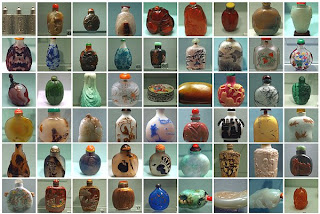
You may click on the image to visit Mingqi Ge's wonderful snuff bottle photographs.I began this series of posts on inspirations with the objects that first fascinated me as a preteen--the tiny snuff bottles in the collection at San Francisco's Asian Museum.


In that first post, I wrote about the varying qualities of translucency among and within each small work. The snuff bottles are very instructive with regard to the effects of glaze transparency, on design, in ceramic.


Ceramic Buttons: ChoirI recently realized that they may have had an even more far reaching effect on my own work. A few days ago, as I was doing some accounting, it occurred to me that, by now, I have made several hundred porcelain buttons--enough to fill a display case. I suddenly began to imagine what they might look like, all together. In my mind's eye, I pondered a "family reunion" of buttons in their own well-lit display case. No sooner did this picture form itself, than the snuff bottles, in their own display case, also appeared!

I was startled at the complementary similarity--the range of colors and textures, and the fact that both were functional work. With the creation of the first, very practical snuff bottle, who could imagine that it might eventually become an art form? And buttons? As I look over the progression in my own work, I see something similar taking place.

Do I know what to call it, or what to think? No. But, I am struck by the fact that it flows against two perennial (and stubborn) barriers to artistic estimation-- especially in the case of ceramic: functional -- and overall in art: small dimensions. Small and functional: potent gatekeepers.

However, the snuff bottles, and other small works I've mentioned in previous posts, seem to have somehow snuck past these two stern guardians! How did they do that? There seems to be some other value operating, one that supersedes the code! But, what is it?

In the case of all of the small work-- necessity, persistence and identity come to mind. The small works, in their service and endurance, have a soul. They are animated by purpose, both practical and artistic...small Pinocchios with true hearts, living lives alongside our own.

Inspire is to breathe life....they inspire me.

Certainly then, they have a soul. A work with soul: that is art.

Inspiring Tutors: Palettes and Proportions

Making solid-colored items, in our favorite hues, is probably where most of us start, no matter what our art or craft of choice. It's easy to pick a favorite and fun to see your work rendered in your favorite color. As time goes on, however, solid colors reach their artistic limits and most of us begin to consider combinations.

It can be intimidating--how to combine colors so that there is more value from both, instead of some garish or childish clash. As beginners, we can be absolutely stunned at the "disappearance" of a beautiful color we thought would be a lovely and eye-catching addition. Colors do such surprising and unexpected things in combination!

The color wheel and color theory provided me with some palette basics, as did the "chips" in the paint aisles of hardware stores. But, it still wasn't enough. Searching for some "way" I could use, I remembered that I'd once chosen to create a palette of glazes, for a class, based on the colors commonly used in Central Asian mosaics. Then, I recalled that I'd been told, as a child, that certain colors "didn't go together," only to discover that Indian textiles regularly incorporated those same colors. So, I went directly to mosaics, carpets and textiles for color combinations "that worked" and practiced them on other objects. Sometimes, I even practiced them first in a graphics program--selecting the colors for a palette, and then coloring shapes and designs in various proportions of each. I could test several variations before translating it into a piece of work.

Playing in graphics programs, I learned that "pleasing" was not just a matter of which colors, but also how much of each. Some colors were only accents and would destroy the harmony if overused. Eventually, I began to use rooms in home decorating magazines, nature shots, advertising pages, and even websites to provide the palettes and proportions for new creations. And, after doing all of this out of an anxious wish to learn "how," I suddenly realized I had already been doing it, naturally, for a very long time.


My Object of Desire
Ever since I was a young teen, I had admired various objects of art, large and small, and wanted to "have one of those!" In most cases, those items were waaaay outside my budget (no teenager budget for antiquities...drat!). In response I would make something that incorporated the colors and spirit of the coveted object, and so, capture it for myself! I "had one," even if I did not, and could not, possess the original item.


My Capture
Across the internet today, there are numerous blogs providing color palettes, in just this way. I find them very inspiring--the only "suggestion" I find missing is proportions. I highly recommend investigating palette collections as a tutor for your work, but you will have to have an eye for the proportion of each color that will make for the pleasing balance you see in the palette's source.


Just as good writers are inevitably lifelong readers of good literature, facility in color and design is born of "reading" good palettes and proportions in nature and in the wider world of art and design.


Some Palette Blogs to Start With--

Design Seeds (favorite)
Displaced Urbanite
Brandi Girl Blog
Purple Lemon Designs

They Influence Me

In my Beads of Clay introduction, I cite several people as sources of inspiration.
I'd like to use this post to introduce three of them, and to say a bit about why and how they have, and continue to, inspire me. Only one is a potter.

View of Liner
Letting the Clay Show Naturally
Shiho Kanzaki's journey to becoming a potter was fraught with difficulties and loss. Destined to be an attorney, he was disowned by his father when he, instead, chose to revivify a pottery tradition native to Shigaraki, Japan. His friendliness to imperfection, naturalness and excellence, as well as his persistence in mastering firing, are a background "music" to my work and thoughts. He is very generous with his knowledge, sharing his firings with many visiting ceramic artists.

His story and aesthetic, in brief
http://www.dicklehman.com/html/writing/kanzaki.html

His work
http://www.etsy.com/shop/kanzakishiho?ref=seller_info

Isn't it noteworthy that he has revived an ancient tradition, yet forges ahead into the most modern venues, online? He is very easy to find, and has a FaceBook page. There, he tells more of his journey. It's extremely interesting and thought-provoking.


4-inch Tile SetsTorso 2I am always aware that ceramic work is a world that exists between earth and glass. Glaze, itself, is a form of glass. As a result, both arts--ceramic and glasswork--share quite a bit of common ground.


Torso 1
I admire Kristin Gudjonsdottir because her work is so original. She often combines glass and clay. She has also improvised many of her own tools and methods and readily shares them on her website: http://art.net/~stina/FAQ.html

My glass tiles with inclusions were inspired by her work, as were these two glass torsos. The bisque molds I made for the torsos were an improvisation on Gudjonsdottirs' own improvised molds.

It also attracts me that many of her large-scale pieces resemble jewelry: http://art.net/~stina/Workmadein94.html


Alla Sviridenko, a silk painter, caught my attention with this statement

"I immediately set to work, experimenting a lot, spoiling plenty of silk but it was nothing. I was making progress, I knew it, but most important was that feeling of satisfaction in my work."

She is one more artist who started with no tradition to support her, no information readily available. Living in Belarus, she had to travel all the way to Moscow to buy her silk painting supplies and had to find her own way--by trial and error--learning with her eyes from the finished work of others.

Kraft Boxes: for PendantsIn the beginning, I had a hard time with my mistakes, and the "waste" they represented. Her words gave me a lot of freedom and truly let me feel that waste was a natural and important part of the process. Her results also gave me a lot of hope that my own waste and efforts in self-education would not be in vain.

The color-freedom and "wasted paper" torn designs of my packaging were inspired by her words.


These three artists are very strong influences on my outlook, my values, and my process. I encourage you to look further into their pages--they are rich.

Inspired Out of All Proportions

During my last year of high school, I was able to take a course in sculpture at the local community college. As I've mentioned in a previous post, the move from high school to college art was quite an eye-opener. One of the most memorable experiences was a class trip to San Francisco MOMA to see Judy Chicago's installation of The Dinner Party. It challenged all of the messages I had received about art and ceramic, up to that point, as well as many of the messages I'd received about myself, as a woman in the arts.

That trip was in stark contrast, however, to another that we took. Our instructor insisted that we attend the California Farm Equipment Show! I was aggravated and I thought he was a bit nutty, and that it was a colossal waste of time. On top of that, it had been raining constantly; the venue was cold, damp and very muddy. However, I made the best of it. My classmate's father farmed raisins and she knew what virtually everything was--

"Wow! What's that thing with all the big shiny disks??"
"Well, Vic...that's a disk-er."

I was in awe of the beautiful disk-er and of deeply treaded tires so huge they towered over me. Here's a disker in action:


After wandering around for a while, it began to dawn on me that our instructor had intended to push us out of the familiar realm of human proportions and into a land of huge abstract sculptures, repetitive patterns, motion machines, and color combinations that were neither urban nor nature-inspired. It was rural and technological, a culture and an aesthetic that were absolutely unique.

Since then, I've discovered that I like looking under the hood, in cars and other machinery.  I have very little doubt that the distributor cap on the left inspired the button on the right:

Translucent Porcelain
Thing #1
Distributor on a Welder


Metallic Tread
Basaltic Stoneware

Diane Kohne's industrial photos often provide inspiration. Compare the "button" in the photo at the top of this page with the button at left.


Where else do I find large machinery? Carnival rides are fascinating, both their mechanical articulations and their outrageous colors. The real-life tonka toys at construction sites call my name.


Thing #2
Selenoid
 When I can, I take pictures, re-color them,
invert them, mirror them, miniaturize them...
all out of proportion.


Not infrequently, I find myself looking at the inspiration for my next pendant, button or bead.

Porcelain

Ceramic in Translation

These days I'm cooking nourishing food, fancy food even, and not clay. I'm sure I'm not alone!

In the interest of honoring those of us with dual roles, adding to our pleasure and not our  stress (my own included), I'm sharing an inspirational "thing I do" to expand my visual library.

By now, you know I love to explore history and culture. So, this post is about tapping cultural resources...directly. I like to search the web's ceramic images in primary languages. Rather than typing "Persian ceramic" and doing an English-language based search, it's a lot more fun, and informative, to go to an image search engine and enter "ceramic art," in Persian: هنر سرامیک

See what I mean?

*So, in the interest of "holiday-easy," here's a quick list, a visual library of ceramic images, from around the world:

Danish - keramisk kunst

Russian - керамика

Turkish - polikrom seramik

Indonesian - seramik sanatı

*These links go very well with a glass of port.


So, my challenge:

Add to this collection in the Comments section!

What country's ceramics interest you? Some countries with large clay deposits, to start with: Ukraine, Brazil, Armenia, Peru. (Aside from Afrikaans, sub-saharan Africa is represented in Google Translate only by Swahili & it works poorly: hmm! It is always instructive to learn who, and what, is being left out.)


How to for any language:

1. Go to Google Translate and enter the English term(s) you would like to use.
2. Choose your target language.
3. Highlight the translation, opposite click and choose Google search.
4. At the search page, choose Images from top bar (far left).
5. To refine further: at Images page, choose "By subject" from the left menu.
6. Choose "sorted by relevance" when you arrive on the page that is returned.
7. Options 5 &6 are not available for all languages

Suggested terms:

ceramic art
polychrome ceramic
traditional ceramic art
ceramic tile
ceramic decorative arts

No Small Thing: Spindle Whorls

Sometimes I am inspired by very simple things. Reading in archaeological accounts about the various items found in women's and children's graves around the world, I felt remarkably tender about the buttons, small beads and other artifacts of their daily lives that they took with them, on final journeys.


One item, in particular, held my attention. Often buried with women and children, across cultures and throughout history, it was the spindle. Usually a wooden stick, with a heavy donut-shaped disk or fat bead affixed near one end, they look like an oversized child's top. Spun, while holding onto attached fiber that is twisted by the motion, they are used to make the thread used for knitting, or weaving--even today. 


Spindle whorlsThey are an essential and very portable machine, the heavy disk functioning as a flywheel, providing balance while helping to maintain the momentum of the spin. And, when graves are uncovered, it is only these disks, the whorls--frequently made out of metal, stone, ivory, glass, or clay--that remain.


Picture 121 Spindle WhorlBuried with both women and children, spindle whorls speak to me of the close connections, historically, between women's work and children's  lives. For me, they also suggest the roots of significant differences, that still persist, in how women frequently frame work--not as a means of acquisition, but as an act of clothing--one's own and one's community. As a result, I find the spindle whorls simple, but profoundly meaningful. In their form and purpose, they mimic women's lives...across the centuries and around the world.


I first made spindle-whorl based necklaces for myself. I wore them to work; they were my response to the tie, on many different levels. Later, I made and sold them to other women. They continue to be well-received, whenever I show them. 


Considering their meaning and persistence throughout the ages, I am not surprised. They are no small thing.

Virtues in Miniature

My introduction to etegami via Deborah Davidson coincided with a personal awakening: my buttons actually function as canvases. Since then, I have often been looking at her work, admiring and learning from it, as well as reading her blog. Trying to imagine myself painting in such a small format, then realizing that I do, has spawned a number of very helpful internal dialogues. For this post, I decided to create a new dialogue, an external one, and interview Debbie. The values underlying etegami have a lot to say to the small canvas represented by beads, pendants and other small format ceramic.

Debbie, what is etegami?

Etegami is first and foremost a kind of mailable folk art ("e" means art; "tegami" means letter). It consists of simple hand-painted images accompanied by a few hand-written words, usually on a postcard. The Japanese have a long tradition of sending greetings to one another in the form of hand-painted greeting cards with brief (often formulaic) phrases deemed appropriate for the season or purpose. What  differentiates Etegami from the more formal arts using similar tools and inks, such as Haiga and Sumi-e, is that it is more spontaneous, more colorful, and it depicts ordinary things from everyday life.

Etegami are almost always painted on postcards of 10 cm x 15 cm (roughly 4 inches x 6 inches) in size. But Etegami supply shops will occasionally sell cards that are up to twice as long, or twice as wide, or more rarely, cards that are irregularly shaped and which must be placed in envelopes if they are to be sent through the post.

Etegami is not Fine Art, and originals are not normally bought and sold. Printed postcard sets or printed calendars of the works of popular etegami artists can be purchased fairly cheaply.


When did etegami gain the popularity it has now?

In the 1970s, the artist Koike Kunio popularized the Etegami motto that translates roughly to: "Clumsy is not a problem. Clumsy is actually an asset in Etegami." This way of thinking made Etegami fun and accessible to people  who didn't have the time or inclination to take on a hobby with lots of rules that would take ages to master.


This sounds unlikely; how is clumsiness is a virtue?

 For one thing, excessive concern about perfection reveals that the artist is concerned more about the work itself than about the intended recipient. Such self-absorption is unseemly. For another, the "clumsiness" referred to here  is not purposeful clumsiness, but natural and childlike awkwardness, which are desirable qualities and evidence of spontaneity. Etegami should come from the heart.

Leaving something less than perfect/complete is desirable in that it leaves room for growth. And anyway, the idea that man would try to create something perfect smacks of unbecoming pridefulness in a culture that traditionally values humility.


Celebrating clumsiness is a bit unusual to hear. Is waste ever a worry? Do new etegami students express concern about "messing up the card?"

I haven't had much experience being among "students" of etegami, but I can tell you what my own concerns were when I was a beginner. I had been taught that there was no such thing as a failed etegami and that I must mail off every card I painted. This was difficult for me, not because I compared my work with other etegami artists, but because I compared each of my pieces with the image I had in my head-- how I had wanted it to end up looking. I did, however, mail each of my pieces-- even the ones I wasn't happy with-- usually to other etegami artists, who would give me valuable feedback and encouragement.

As I became more experienced, I finally grasped the concept that I wasn't meant to be in control of the process. That the way I was taught to hold the brush pen, the bleed of the paper, and other factors, all contributed to preventing the artist from having too much control of the results. I learned to appreciate the "accidents" and since there was no fixing the results, I learned to relax and enjoy the way the tools and materials took the control away from me.

The initial investment in tools and paper is not cheap, but the tools and paints last for years, and washi cards come in a wide range of prices. In the beginning I used the cheap cards that were mass-produced and didn't have much bleed. Nowadays I use more expensive, hand-produced cards that I have to order specially because I'm no longer satisfied with the way the cheaper cards respond to my ink. I can see where a young person without much money, or a retired person on a fixed income might worry a bit about cost of materials. Even so, I think Etegami is a lot cheaper to do than most forms of art that people pursue as a hobby.

I think waste, when your budget is limited, can be troubling. Also, some of us grew up with "waste not, want not." It's deeply ingrained. My own mind, and my work, changed when I decided that less glorious results were not "trash," or a waste, but the mother of my success...in some ways more valuable than beautiful pieces. Not seeing mistakes as trash changed how I used my materials and also gave me lots of freedom to try anything. I don't know how other people leave the place of worrying about "waste," but for me, waste ended as a concept when all the work became "good."

That is close to what I was trying to say. Except that, strictly speaking, we're not even supposed to think in terms of success. There is no "failure" in etegami.

Wow...an art form valuing clumsiness, that has neither success nor failure as guidelines, is very challenging, and thought-provoking.

One thing that always speaks to me from your work are your cropped images--that you let a portion stand for the whole. Can you say something about the freedom to fill the whole space, and STILL not "finish" the picture? I think this is really challenging, but so important. Overworking a piece is counterproductive, and even more so in such a small space. How do you know when you are finished?

When we paint etegami, we place the washi card on a larger sheet of washi (cheap, thin sheets), partly to protect the work surface from the ink, but also to extent the boundary of the card itself. We try not to "frame" the image within the borders of the card, but let our brush strokes extend beyond the card to the sheet of washi behind it. That's why the finished image on the card looks cropped. Children do this quite naturally, but inexperienced adult artists are often inhibited by the dimensions of the card and have trouble ignoring the boundaries. They will try to "center" the image on the card, which results in the image appearing small and tight.

I've already addressed the issue of "when is the painting finished?" in previous responses, but to repeat an important factor, the traditional Japanese aesthetic has always valued minimalism and just-short-of-completeness, so an etegami artist who has any appreciation for traditional Japanese art will recognize this, and it will affect the way he paints. I was taught to use no more than three colors and to leave the background of the image blank. I've noticed that many etegami artists do use lots of colors and will fill in the background, especially if they're painting a scene, rather than an object. But in my opinion, it makes the work appear like any other watercolor painting, rather than an etegami.

Sometimes I think the freedom to leave “unfinished”, or to crop, has to do with getting away from the (concrete) idea that the picture is really the object (which I think is behind the "completeness" idea that requires the whole item to be shown) and grasping the idea that the picture is a suggestion of... many other things, sometimes the object , but often an idea or a feeling.

You expressed it well. Etegami is the suggestion of something (an experience, a thought, an object) that extends beyond the painted image. Just as Haiku suggests in a few lines a much bigger situation or feeling.


Many thanks, Deborah. You've already given me a lot to think about over the last months. Now, I will be pondering the restrictions that can be engendered by my concept of success! 

Deborah Davidson is a professional translator and Etegami artist based in Hokkaido, the gorgeous northernmost island/prefecture of Japan. Her series, Humanizing the Quake, is a particular favorite.

Netsuke: Solving Problems Elegantly

In my last two posts, I wrote about Chinese snuff bottles and about the tradition of Persian and Moghul miniature painting. In this post, I’d like to share a bit about a Japanese miniature art form: netsuke. The joint ornamental and functional nature of netsuke is a continuing inspiration.

If you'll look carefully at Japanese paintings and drawings from the past, you will notice that earrings, necklaces and bracelets are nowhere to be found. Items designed exclusively for personal ornamentation were virtually non-existent. Instead, items of dress and personal use, such as clothing and hair combs, were ornate. Objects of common use were turned into objects of art; the practical was elegant. This stands in strong contrast to many of our own “necessary objects,” which tend to have a utilitarian design one would not really characterize as “beautiful,” or consider a work of art (just think of the wall of fasteners in your local fabric shop, to get an idea of what I'm talking about).

Bead-style Japanese netsuke. Photo by David Wicks.Netsuke started out as a common bead, attached to the cords of a small pouch, which hung from the belt over a kimono or hakama. They probably originated in China. The function of the netsuke was to keep the cord from slipping out from under the belt, so one didn’t lose the attached pouch. Kimonos didn’t have pockets (when I think of all the things I really didn’t want to put through the wash, this seems brilliant). Over time, netsuke became more and more ornate, carved of various materials, in the shape of animals, people, nature, and fantasy. They could signal many things, including the profession and status of their wearer.

Netsuke inspire me not only because of their unique and often clever beauty, but also because they have introduced a new dimension into my work. They join two things often put into separate “boxes” here in the US: problem-solving and beauty.

Porcelain button by VIKA, used as a hair fastener.Buttons solve the problem of fastening clothing. Fibulae solve the problem of fastening a jacket, shawl or scarf. A snap or tie could also solve these problems, but thinking about netsuke allowed me to see decorative ceramic as a more elegant and personal solution. This has opened up many possibilities. Recently, it resulted in my buttoning up my hair.

What have you created already that solves a problem and adds aesthetic value, or makes a personal statement? What else can you think of for fastening hair, clothing, or footwear? How about for securing items that should not fall out of your pocket, such as keys, cell phones, glasses, or cards? These are all candidates for a netsuke-type counterweight solution. What do you set on the table when you sit down? Better yet, what do you lose all the time!? Where and how else could these items be “fastened?” Does another culture or time period already have an elegant solution: could it be rendered in ceramic?

Netsuke challenge us to move beyond producing beads and the exclusively ornamental. They encourage us to see the possibilities in very functional, problem-solving objects and to imagine a new life for them— as objects of art.

Moghuls & Miniatures: Does Size Matter?

This entry comes second, but really serves as an introduction to my interest in small format art around the world, so it is a little bit longer.

As a high school student, my schedule permitted me to take a sculpture class at the nearby community college. To my surprise, I discovered we would be working with live models. After my initial shock at seeing naked people in the classroom, I was forced to wonder about the arbitrary division that made me an adult in one context, and a powerless child in the other!

I soon learned of another arbitrary division, one that I continue to question: size. My sculpted nudes were all sized to fit within the grasp of two hands. The instructor repeatedly commented on my "small work." Finally, he diagnosed me as "inhibited" before the class! It's embarrassing to be singled out and judged when you are a high school student among adults. I didn't know how to respond. I wish he had asked me for my rationale. Articulating what made me "work small" would have been so enlightening and helped me develop as an artist. I felt there was a difference between walking around a sculpture, and being able to see all sides at once, being able to intimately examine the form with one's hands, not just observe it with one sense--the eyes. Besides, everyone's work was smaller than the actual model; how was "too small" determined? How and why did it diminish value? Apparently, size mattered, but not in any way that had been articulated. I'm sad to say that I have only one piece left from that class, a "large" work that I completed in order to satisfy him, and that won a ribbon. I eventually tossed all the others.

Years later, I discovered that many cultures celebrate small format art. One of my earliest introductions was a display of Moghul miniatures, also often referred to as Persian miniatures, which were the source of Moghul inspiration. The miniatures have informed my work in three areas: story, space, and succinctness. Most were created around a story or poem, there are versions that fill the space and those that are conspicuous for their amount of "emptiness," but none have any "extra."


* *

It's difficult to pick up one of my pieces that does not have a story behind it. Just as the Persian miniatures are icons that have the power to include the viewer in a long ago experience or emotion, mine are also connected to real events. I didn't think this was possible; I thought they would simply be perceived as motifs. But, I have been surprised at the number of people who react viscerally to the designs, and how evocative they are of others' personal experiences. The spirit and story of the artist goes into their work. How would you convert one of your own vivid experiences into a color? A symbol?

Persian miniatures also teach about space. It's amazing to me that some entirely fill the field, while others are spare and uniquely balanced--large fields of color fill the "empty" space. The latter remind me of the most modern stage sets: open geometric spaces infused with hues of varying values that whisper or shout a background truth to frame the action in a small, concentrated portion of the stage.


There is a natural anxiety about emptiness that involves a certain perception of incompleteness (like "too small!"), but it can be very powerful.


Sometimes, you need everything to tell the story. What is amazing about the Persian miniatures is that even when the entire space is filled with people and objects, there is no "extra." Frames--around the paintings and within them--keep things concise. See the "bead" in this miniature? Try drawing a circle around a bead’s holes, or a square frame on each side of a square bead.


www.joanmiller.com Porcelain BeadThere can be a lot of pattern, but it is used to separate elements, so they’re not lost in the crowd. The paintings are succinct: everything contributes to the story--no "fluff." The "story" on Joan Miller's bead is clear. Every character belongs there. As in the miniatures, minor design elements become a patterned background, a container for the story.


Two great empires thought small was magnificent. What did I learn from them? Small art is intimate--not for the inhibited, visually powerful when it is concise, and ultimately, precious.

In a Mood with Translucency: Glaze Choices

The small has always fascinated me, and it "just doesn't get any respect!" As a pre-teen at the Asian Museum in San Francisco, it was hard to pull me away from the display of tiny snuff bottles--not just the first time, but every time we visited!

You may click on the image to visit Mingqi Ge's wonderful snuff bottle photographs.As you can see in the image Mingqi Ge allowed me to use (for a closer view, his Flickr set is linked ), they are made of every substance imaginable, many of glass or natural stone, and the light responds differently to each one. One of the most important things I learned from them, with regard to designing small spaces, is the importance of translucency--the depth to which light penetrates a design's material.

Although there are points in between, light either passes all the way through, bounces directly off the surface, or is reflected from some point below the surface. Each of these variations produces a different effect. (Some of the snuff bottles combine differing translucencies, in order to create a sense of depth of background for a design on the foreground.)

Just as lighting can be used to create mood in a room, translucency can be tuned to create a mood for your design. Orange candies are a good example. A sparkling, clear hard candy has a clean fresh connotation.

Rutile glaze. Some light passes through to the clay; the rutile causes some to be refracted, creating an intermediary depth.One with the same surface but a cream filling creates a sense of mystery and promise.


The opaque pink creates a bold frame for the design.However, an orange gumball is forthright, or even comedic, in its bold simplicity and lack of "depth."


The clear green glaze, against translucent porcelain, seems almost bottomless. Glaze and clay combinations hold the same potential. A clear glaze merges with translucent porcelain into a glass-like surface that glows with elegance. The same bead or pendant rendered in white stoneware with a semi-opaque glaze is more sedate, with an inner glow. While the first can be cold, the second is often warm. The same bead rendered in an opaque glaze will speak more loudly of the bead's design (or lack thereof!) and of your choice of color.

Try a glaze of the same color, but different translucency, on one of your standard bead or pendant designs--you may see an entirely new piece of work emerge, as you observe it in a different light!